
From a paper diary
to a proper academy engine.
How a Pontefract grassroots coaching business got a custom-coded platform that keeps admin under control and parents in the loop.
(May 2025 – Apr 2026)
in platform
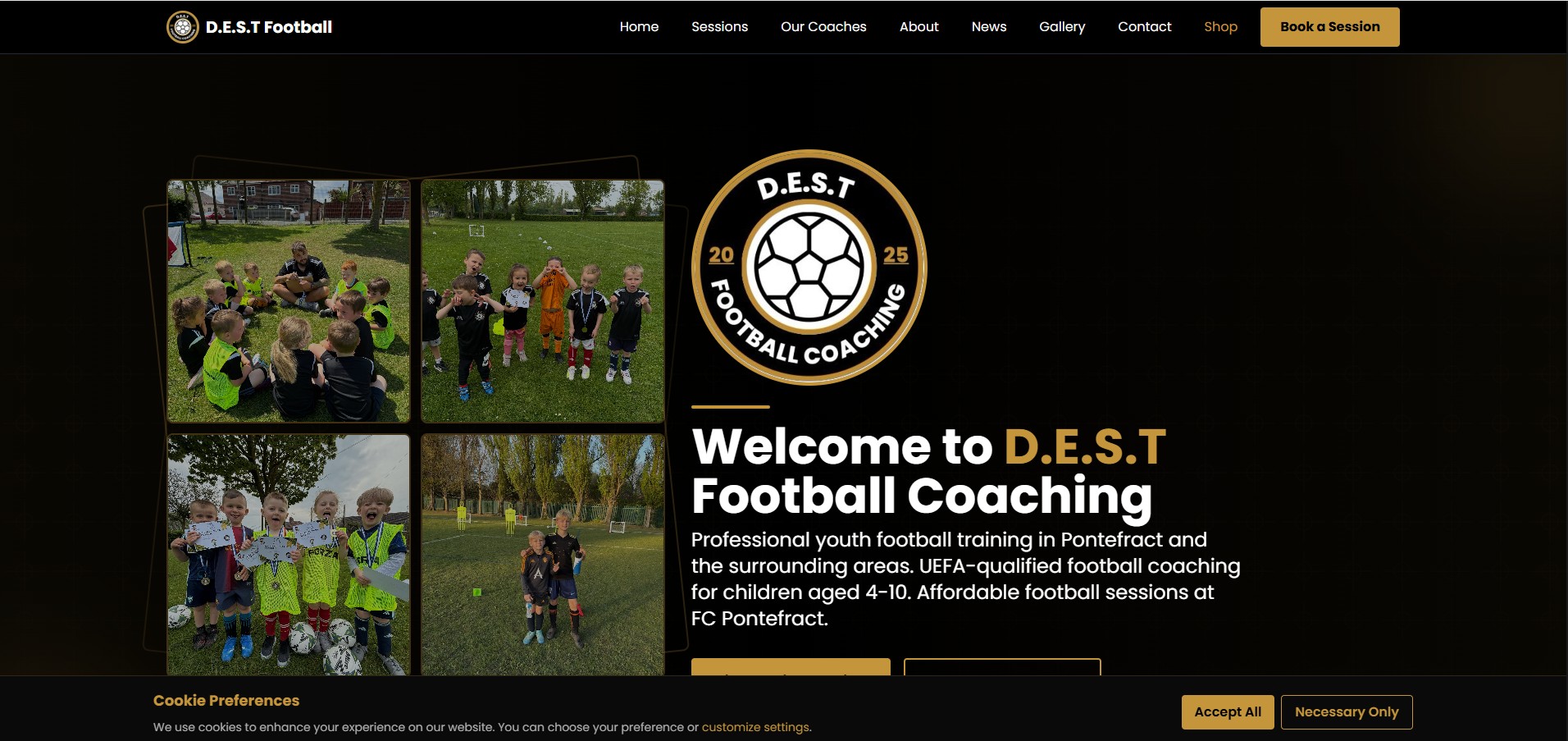
Growing pains
Meet Dave. He built D.E.S.T Football Coaching in Pontefract around something simple: coach kids properly, keep it friendly, and don't price local families out. The coaching side was working. The operational side was not.
As sessions, children, and parent comms grew, the old way of managing things started to creak. Parents still needed clear answers about sessions, availability, and pricing. Coaches still needed accurate lists of who was attending which session. Admin still had to happen — but the tools to handle it were a paper diary and a WhatsApp inbox.
This wasn't a coaching problem. It was an operational drag problem — and it was pulling Dave's attention away from the pitch.
Grassroots, not corporate
"Friendly local coach. UEFA standards. No nonsense."
That line shaped everything — the copy, the structure, the booking flow, the parent comms. Every decision came back to it.
The voice
Parents in Pontefract do not want polished waffle. They want clear details, honest pricing, and reassurance their child will be looked after. So the copy direction stayed straight-talking, grounded, and child-first. Every page answers the question a cautious parent is actually asking — not the one a marketing agency would write.
The trust signal
The pay-per-session model is a genuine trust lever for families who have been burned by lock-in memberships elsewhere. It needed to be visible, clear, and repeated in the right places — on the homepage, in the booking flow, in the FAQ. Not buried in small print.
The real goal
Not "look bigger." Not "sound premium." Give local parents confidence to take the next step today. If a parent lands on the site at 9pm after a long day, worried their shy child won't fit in, the site has to answer that worry in seconds — not scrolls.
The academy engine
We built a custom-coded PHP platform that handles public pages, a parent portal, and coach and admin operations in one coherent system. Not three separate tools that sort-of talk to each other — one platform where every part knows about every other part.
The fixtures board
Session data is managed with date-specific availability, not broad assumptions. Parents can browse valid dates and book against real capacity. When a session hits capacity, it stops showing — no double-bookings, no phone calls to check.
The parent tunnel
Registration, login, child profiles, bookings, and notifications live in a dedicated parent portal flow. It's practical, low friction, and built around real family logistics — parents with multiple children manage all profiles under one account.
The backroom staff
Admin and coach tools cover sessions, bookings, attendance, feedback, messaging, content updates, and reporting. The result is one operational engine — not disconnected manual work held together by WhatsApp and hope.
The jargon
"A custom PHP MVC-lite architecture with transactional booking flows."
The reality: one reliable matchday clipboard, not ten scraps of paper that can get out of sync.
No lock-in, no stress
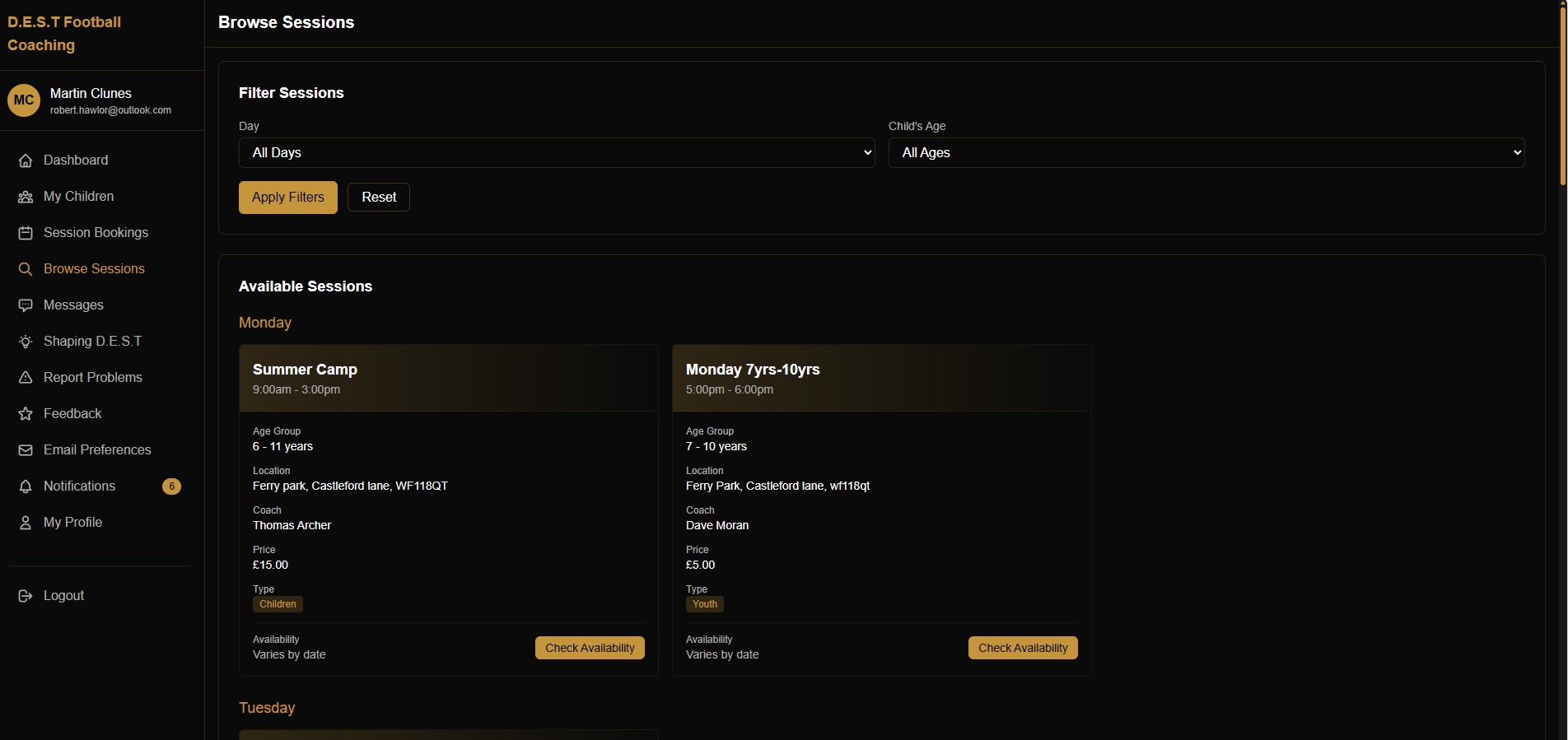
The strongest part of this build is not flashy UI. It is clarity at the exact moment a parent is unsure. Known objections — lock-in contracts, shy children, bad past experiences — were handled directly in the messaging strategy. Named clearly, answered directly. And the parent portal puts it all one tap away.
Desktop: full parent dashboard
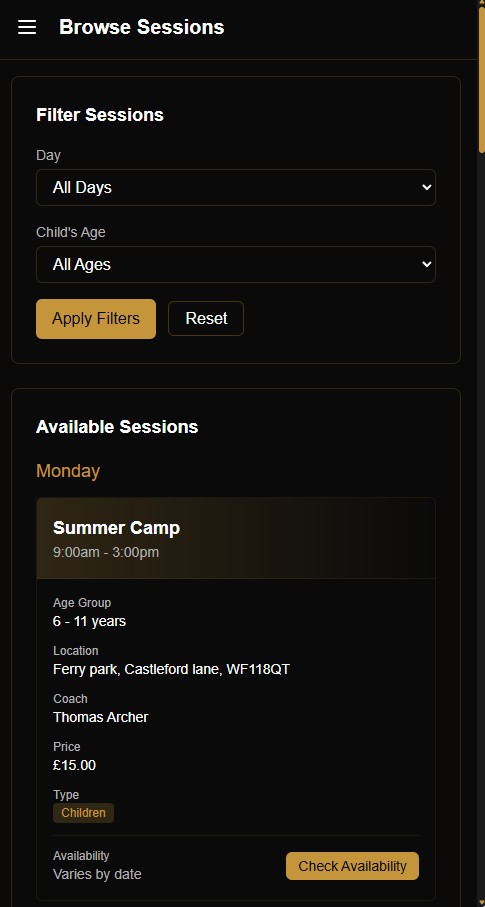
Mobile: book on the go
What the platform runs on today
bookings have been tracked in the live data window analysed
parent records are managed in-system
transactional emails have been logged through template-led flows
core database tables powering the platform
Session, portal, and admin journeys now run inside one custom-coded architecture. The platform handles bookings, attendance, parent communication, content updates, and reporting without third-party plugins or monthly SaaS fees.
The human outcome is simple: less guesswork for staff, clearer journeys for parents, and more headspace for coaching.
How we built it
The Stack
D.E.S.T runs on a custom PHP architecture with server-rendered pages and API endpoints, deployed on cPanel with PHP 8.2. Data is handled through PDO with native prepared statements — no ORM overhead, just direct, parameterised queries. Transactional email is powered by PHPMailer with dotenv-driven configuration.
The front-end pipeline uses TailwindCSS, PostCSS, and Autoprefixer. Public site, admin area, and parent portal all compile to separate minified CSS targets, which keeps each area focused and lean. No megabyte of unused CSS bleeding across contexts.
The Hardest Hurdle
Booking-state integrity across parent and admin workflows. It is not enough to save a booking record — the system has to keep date-level availability, booking status, attendance context, notifications, and email side-effects aligned while different users can update records at different times.
If this layer drifts, parents get wrong confirmations, sessions get overbooked, and staff lose trust in the platform. So booking flows use explicit validation and transactional writes where consistency matters most. No race conditions. No ghost bookings.
How the Booking System Works
Booking flow logic validates required fields, confirms date availability, checks child ownership and age fit, blocks duplicate active bookings, and then writes records through controlled database operations. Admin booking management applies allowed status transitions and updates communication side-effects through notifications and template-driven email routines.
Security controls include CSRF protection, rate limiting, reCAPTCHA verification, secure session configuration, and hardening headers at server level. This is defence-in-depth — not a single checkbox.
The architecture also supports content operations through built-in admin tools for news, gallery, feedback moderation, and reporting, so D.E.S.T can maintain momentum without bolting on third-party plugins or paying monthly for features they should own.
Performance by Restraint
The core performance strength here is architectural restraint. This is custom-coded infrastructure, not a plugin stack carrying unnecessary runtime weight. Every included library has a job. Nothing is loaded "just in case."
Build and deploy practices reduce clutter, static assets are compressed and cached aggressively via Apache directives, and analytics pathways are designed with pre-aggregated daily data to avoid repeatedly heavy reads for dashboard views. The result is a practical platform that stays maintainable as coaching operations grow — not one that gets slower with every new season.
Under the bonnet
{
  "project": "D.E.S.T Football Coaching",
  "build_type": "Custom-coded PHP platform + parent portal + admin system",
  "runtime": "PHP 8.2 on cPanel",
  "frontend": ["TailwindCSS 3.4.17", "PostCSS", "Alpine.js"],
  "backend": ["PDO", "PHPMailer", "Dotenv"],
  "security_controls": [
    "CSRF token verification",
    "reCAPTCHA v3 on key forms",
    "login rate limiting (5 attempts / 15 mins)",
    "security headers via .htaccess",
    "session hardening"
  ],
  "verified_platform_stats": {
    "bookings": 427,
    "parent_records": "135+",
    "email_log_entries": 291,
    "core_tables": 24
  },
  "note": "No CMS or page-builder dependency in core architecture"
}What Dave says
"Rob and Blue Penguin Digital have made us at D.E.S.T Football Coaching an absolute masterpiece of a website! The feedback with how the website works has been astonishing. These guys have 1000% hit the nail on the head with how we wanted it to look, work and for it to be easy to use for the public. We've achieved this and more — we can't recommend these guys enough!"
Ready to run your coaching operation without the admin scramble?
If you want a custom-coded platform that gives parents clarity and gives your team breathing room, start here.
More case studies
See what else we've built — hand-coded, no templates.