A "free" website sounds like the easiest business decision you'll make this year. No upfront cost. Built in a few days. What's the catch?
The catch is that the website isn't the product. The hosting is.
That doesn't make it a scam. But it does make "free" the wrong word for what you're actually signing up for.
How the "free website" model actually works
You fill in a short form describing your business. A few days later, you have a live website. You haven't paid a penny.
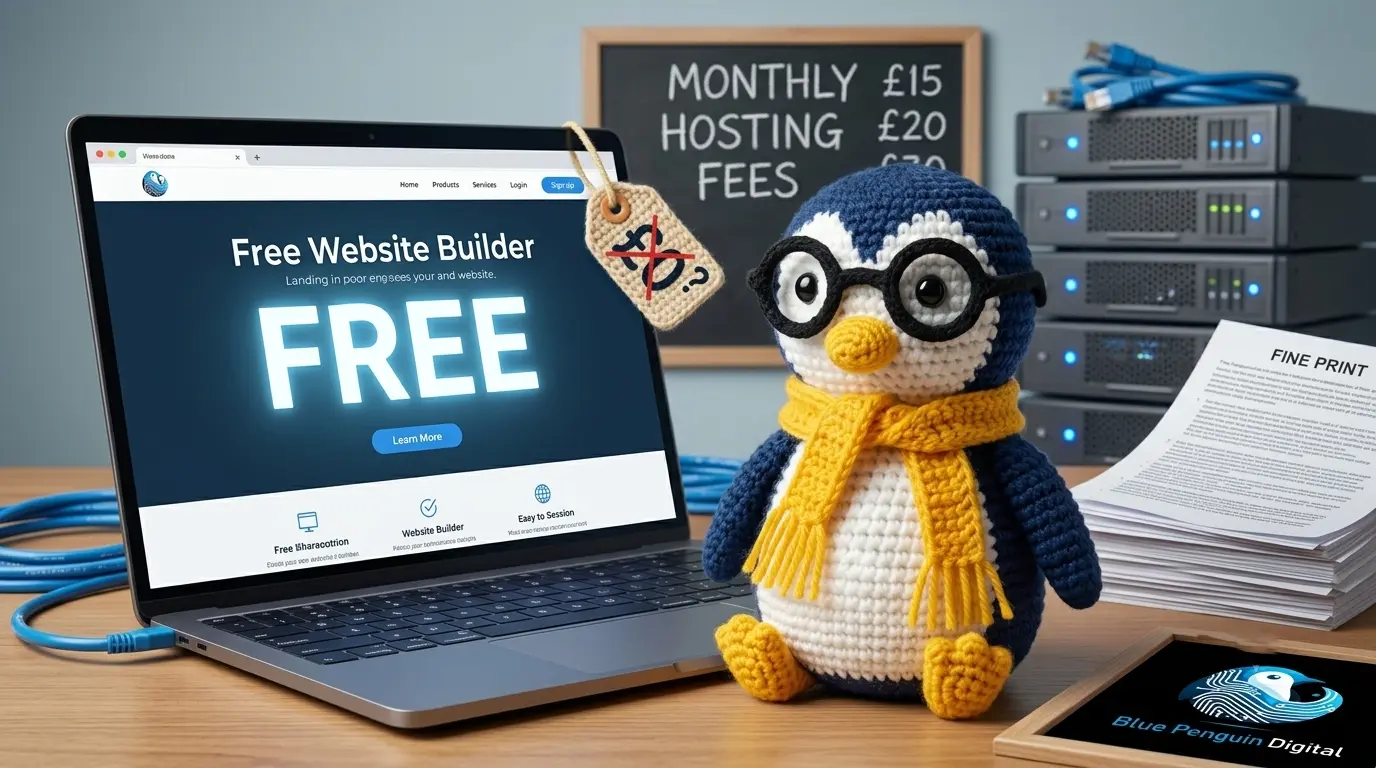
Then the monthly hosting charge begins. Typically somewhere around £20 per month.
The site lives on the provider's platform, inside their proprietary editor. You can edit the content — swap text, change images — but you can't take the site with you. Cancel the hosting, and the website disappears.
That's the deal. A website in exchange for a hosting subscription you can't cancel without losing everything.
What each path actually costs
Let's be straight: the "free" site is cheaper on paper. Over five years, £1,200 for a live website versus £2,400–3,300 for a custom build. If this were purely a price comparison, the subscription would win.
But it's not. It's a comparison between renting and owning.
The "free" website, £20/month: You pay £240 a year — forever. Year 10: £2,400. Year 15: £3,600. Cancel at any point, and the site disappears. You never reach a point where it's paid off. The meter runs until you quit or the business closes.
A custom build, one-off cost: The build is a one-time payment. After that, you're paying for actual hosting — £15/month through a provider like Unity Tech, or less if you shop around. The site is yours. You can take it anywhere. The build cost is an investment in an asset; the hosting is the utility bill.
The subscription model isn't a scam. But it is a permanent expense for a temporary arrangement. That's fine if you're happy renting. It's worth understanding that's what you're doing.
What you're actually getting
These services build a lot of websites. One provider we looked at claims over 5,000. That's not a workshop producing bespoke work — that's an assembly line.
The business model depends on speed. A site built in two or three days isn't being designed from scratch. It's being assembled from a library of templates and populated with your content.
That might be fine. A clean, functional template site that represents your business competently is better than nothing. Plenty of small businesses don't need anything more.
But you should know what you're getting. It's not custom design. It's not bespoke development. It's a pre-built framework with your name on it — and it lives on someone else's platform, in someone else's editor, on someone else's terms.
Five questions to ask before signing up
If you're considering a "free" website, ask the provider these questions:
- Can I export my site and host it elsewhere? If the answer is no, you're renting, not buying.
- What happens when I cancel? If the site disappears, that £20/month isn't hosting — it's a subscription fee for continued access.
- Who owns the code and the content? If you can't walk away with both, you don't own anything.
- What's the actual hosting quality? Shared hosting worth £5/month sold at a 4x markup is the business model. Are you getting £20/month worth of performance?
- Can I add features later without paying more? If every plugin or extra page costs extra, the "free" build doesn't look so free anymore.
When a "free" site makes sense
We're not going to pretend this model has no place. If you're a sole trader who needs something online quickly, and you're happy paying a monthly fee indefinitely for a maintained site you never need to think about, it works.
It's essentially website-as-a-service. Like renting office space instead of buying. The tradeoffs are clear, and if you're fine with them, go ahead.
When it doesn't
If your website is a business asset — something that should grow with you, rank well, and belong to you — the subscription model works against you.
You pay more over time for less control. You can't move to better hosting if your site slows down. You can't hire a different developer to add something custom. You're locked into one provider's ecosystem, and the switching cost is starting from zero.
That's the real cost. Not the monthly fee. The fact that you're building on rented ground.
The alternative: own your site
You can pay once for a site built properly — no templates, no page builders, no proprietary lock-in. Static HTML, fast hosting, clean code. If you ever want to move, you take the files and go.
Hosting starts at £15 a month through our hosting partner, Unity Tech. Or you can host it anywhere you like. It's your site. You're not renting it from us.
The build costs more upfront. But unlike the subscription, the cost has an end date. Once it's paid, you own something that lasts. And if your business grows — or your needs change — you're not stuck asking one provider for permission to improve your own site.
We think that's the better deal. But we would — we build proper websites.
Want to understand what a proper build actually involves? Read our guide to how we work — no mystery, no upsells, just how it's done.