
18 years. 7 continents.
No website.
How we built Andrew Dewar's brand identity and 22-page digital platform from a blank page — in nine months, by hand. Zero WordPress. Built to last.

18 years of mastery. Nowhere to show it.
Meet Andrew Dewar. He has spent 18 years designing fashion that gets made — properly. Technical files so precise that manufacturers in China, India, Portugal, and Turkey can execute from them without a single clarification call. Over $100M in client sales generated from his designs. More than 10,000 technical files delivered. Over 100 brands served across 7 continents.
In May 2025, when Andrew decided to launch Fashions Tomorrow as his commercial studio, he had all of that — and no way to show it. No website. No brand identity. Not even a logo. An 18-year veteran with a global track record, completely invisible to search, to social proof, to inbound discovery.
The complexity made a quick fix impossible. Fashions Tomorrow isn't one service — it's eight: menswear, womenswear, unisex collections, childrenswear, product design, sustainability consulting, factory sourcing, and trend forecasting. Each has a different buyer. Each needs its own positioning. A Wix template wasn't going to cut it.
What was missing
- No brand identity — no name, no visual system, no voice, no positioning
- No digital presence — 18 years of expertise invisible to search engines
- No trust mechanism — international clients had no way to verify credentials remotely
- No platform for differentiators — 11-step process, AI-assisted workflow, Fabric Library all locked in Andrew's head
- No editorial authority — two decades of insight with no publishing home
- No client qualification path — high-value projects (often £10k+) need a consultation-first funnel
Building the brand from nothing
Before a single line of code was written, we had to build the brand itself. Not a logo and a colour palette — a complete commercial identity: positioning, voice, visual system, competitive strategy, and the vocabulary to carry it all. This wasn't a rebrand. This was creation from a blank page.
The Discovery
We started where every solid brand build starts: understanding what Andrew actually does, who he serves, and what makes Fashions Tomorrow different. The answer wasn't in the services list. It was in how Andrew works. He takes a brand founder from initial concept through to factory delivery — creative and technical, end to end. Most design studios stop at the creative phase. Most technical studios don't do creative work. Andrew does both.
One phrase from early discovery work became the entire brand strategy: "Obsessively crafted. Quietly authoritative. Built for what's next."
The Positioning
We ran a full brand archetype analysis. Fashions Tomorrow sits cleanly in the Creator archetype — innovation and expression, not heritage or hype. We mapped the brand across Aaker's personality dimensions: Sophistication (primary, black-and-gold premium), Competence (secondary, $100M+ track record), Excitement (tertiary, AI-assisted design and forward forecasting).
The name itself — Fashions Tomorrow — acknowledges the breadth of the work (plural "Fashions": menswear, womenswear, childrenswear, unisex, product design) and the forward-looking positioning ("Tomorrow": trend forecasting runs 1–2 years ahead of market).
Visual Identity
Rich Black (#000000) and Standard Gold (#C4AB52). Geometric gold corner accents on photography. Radial glow effects for depth. Outfit (sans-serif, structure) paired with Cormorant Garamond (serif, elegance). Generous white space — luxury is space.
Voice System
Three adjectives every sentence had to pass: Precise (every word chosen), Visionary (speak from ahead of the market), Crafted (polished, considered, nothing accidental). A 28-word banned list. A CTA micro-copy standards guide. A 3,500-word brand book documenting everything.
Competitive Strategy
Verifiable numbers over vague claims. Sustainability certifications named and cited (OEKO-TEX, GOTS), not greenwashed. Process transparency as differentiation — most competitors hide their methodology. Education-first content that qualifies leads before they enquire.
22 pages. Every one earning its place.
Andrew's offering is wide, deep, and structurally complex. Each service category has its own buyer persona, its own decision-making criteria. A childrenswear brand founder cares about safety compliance. A menswear label scaling into wholesale cares about factory coordination. They're not reading the same page.
The site needed architecture. It needed the kind of page depth you normally only see on WordPress builds with 47 plugins — except we were doing it by hand, with static HTML and a custom build system.
Core Architecture
- → Services hub — 11-step process explained in plain English
- → About Us — founder story, verifiable credentials
- → Our Pledge — sustainability strategy (OEKO-TEX, GOTS cited)
- → Contact — consultation-first funnel, CSRF-protected forms
Collection Categories (4)
- → Mens & Womenswear — flagship offering
- → Unisex Wear — emerging category, progressive positioning
- → Childrenswear — safety-first messaging, compliance focus
- → Product Design — soft goods, explicitly scoped
Resource Pages
Interactive Fabric Library (40+ materials), Tech Pack resource page, and Testimonials — each built as trust mechanisms, not filler.
Editorial Hub
6 published articles from day one — 11,000+ words of original, on-brand, SEO-optimised content. Most agencies launch with placeholder blog posts. We launched with a content library.
Legal & Compliance
Privacy Policy (GDPR), Cookie Policy (SameSite=Strict, no third-party tracking), Terms and Conditions — all tailored to Fashions Tomorrow's operating model.
The Fabric Library: an interactive trust mechanism
When a fashion founder commissions a collection, one of the first conversations is about fabric. Most design studios handle this with a PDF or a Dropbox link. We built an interactive JavaScript-powered fabric browser that clients can explore independently, reference during consultation calls, and use to make informed material decisions before sampling even begins.
What we built
- 40+ named materials with high-resolution swatch photography
- Material descriptions: fibre content, weight, texture, drape
- Sustainability certifications: OEKO-TEX, GOTS, organic, recycled
- Modal-based detailed view — click any fabric for full info
- Responsive grid layout, accessible keyboard navigation
Developer Insight // Winston
"The Fabric Library loads a 12KB JSON object, renders 40+ materials in a responsive grid, and handles modal interactions with zero external dependencies. No React. No Vue. No jQuery. Just clean, vanilla JavaScript that'll still work in 2030."
This could have been a WordPress plugin. We built it as 150 lines of vanilla JavaScript, because that's faster, cleaner, and has zero dependency risk.
Why this matters
For a client evaluating Fashions Tomorrow against competitors, the Fabric Library is proof of capability. It says: "We have relationships with certified mills. We know these materials intimately. We can specify exactly what you're getting before you sign a contract." Most studios claim sustainability. Andrew shows the fabric swatches.
Nine months. No shortcuts.
Nine months is a long time to build a website. If this were a WordPress template job, it would have taken two weeks. A page builder, maybe a month. This wasn't that. This was a full brand identity built from nothing, 22 custom pages, a proper build pipeline, 11,000+ words of editorial content, an interactive Fabric Library, security hardening, and comprehensive SEO automation — all without a single plugin.
Original brief
Brand identity, 8-page website, contact form, basic SEO.
What we actually built
- → 22 pages (not 8)
- → 6 editorial articles (not planned)
- → Interactive Fabric Library (not in original brief)
- → Custom build pipeline with schema automation
- → CSRF-protected forms, honeypot spam traps, rate limiting
- → Full 3,500-word brand book
This is what happens when a client cares about quality and an agency refuses to cut corners to hit a deadline. The project grows into what it needs to be.
A website that thinks like a tech pack
Andrew delivers technical files for a living — specifications precise enough that a factory in Portugal and a factory in China can both execute the same garment without a single clarification email. The website had to operate at the same standard. Not "roughly right." Not "good enough for launch." Every decision made deliberately, for a specific outcome.
Micro-Copy Discipline
Every CTA names the outcome, not the action. "Book a consultation" — not "Contact Us." "Start your collection" — not "Submit." "Stay ahead of the trends" — not "Sign Up." These aren't accidents. They're brand strategy compressed into two or three words.
Verifiable Claims Only
"18+ years" — career start date documented. "$100M+ in client sales" — conservative estimate from known client revenues. "10,000+ technical files" — file archive count, rounded down. "7 continents" — client geographic distribution. No "world-class." No "industry-leading." No "award-winning" without naming the award.
Technical Honesty
OEKO-TEX and GOTS certifications cited by name. No "eco-friendly" greenwashing. Tech Pack page educates first, pitches second. Every sustainability claim is traceable to a named standard.
AI Without the Hype
AI-assisted 3D visualisation positioned as a practical workflow tool — not magic. Copy explains what it does, why it matters, and when it's used. Honest positioning, no buzzwords.
Structural Integrity
Every page: hero statement → problem context → approach → evidence → outcome → CTA. Not a template — a rhythm. Like a well-graded garment pattern, it scales across sizes without breaking.
From invisible to unavoidable
Before March 2026, if you searched for "fashion design services UK," Andrew Dewar didn't exist. Now, Fashions Tomorrow is findable, credible, and built to a standard that matches the calibre of the work Andrew has been doing for 18 years.
Before
- No website
- No brand identity
- No search presence
- No Fabric Library
- No published content
- No client qualification system
- No international credibility
- Template or nothing
After
- 22-page custom platform
- Complete visual system & voice framework
- Organic traffic from editorial content
- 40+ materials, searchable & modal-based
- 11,000+ words across 6 articles
- Consultation-first funnel with editorial qualifier
- Fast, mobile-responsive, 7-continent reach
- Custom build, zero CMS, zero WordPress
What it feels like
Andrew now has a digital platform that matches the calibre of the work he's been doing for 18 years. When he shares the URL in a pitch, he's not apologising for a placeholder site. When a referral partner sends a client his way, that client lands on a platform that looks like it's been operating at serious scale for years — because the expertise behind it has been.
Desktop: the full editorial homepage
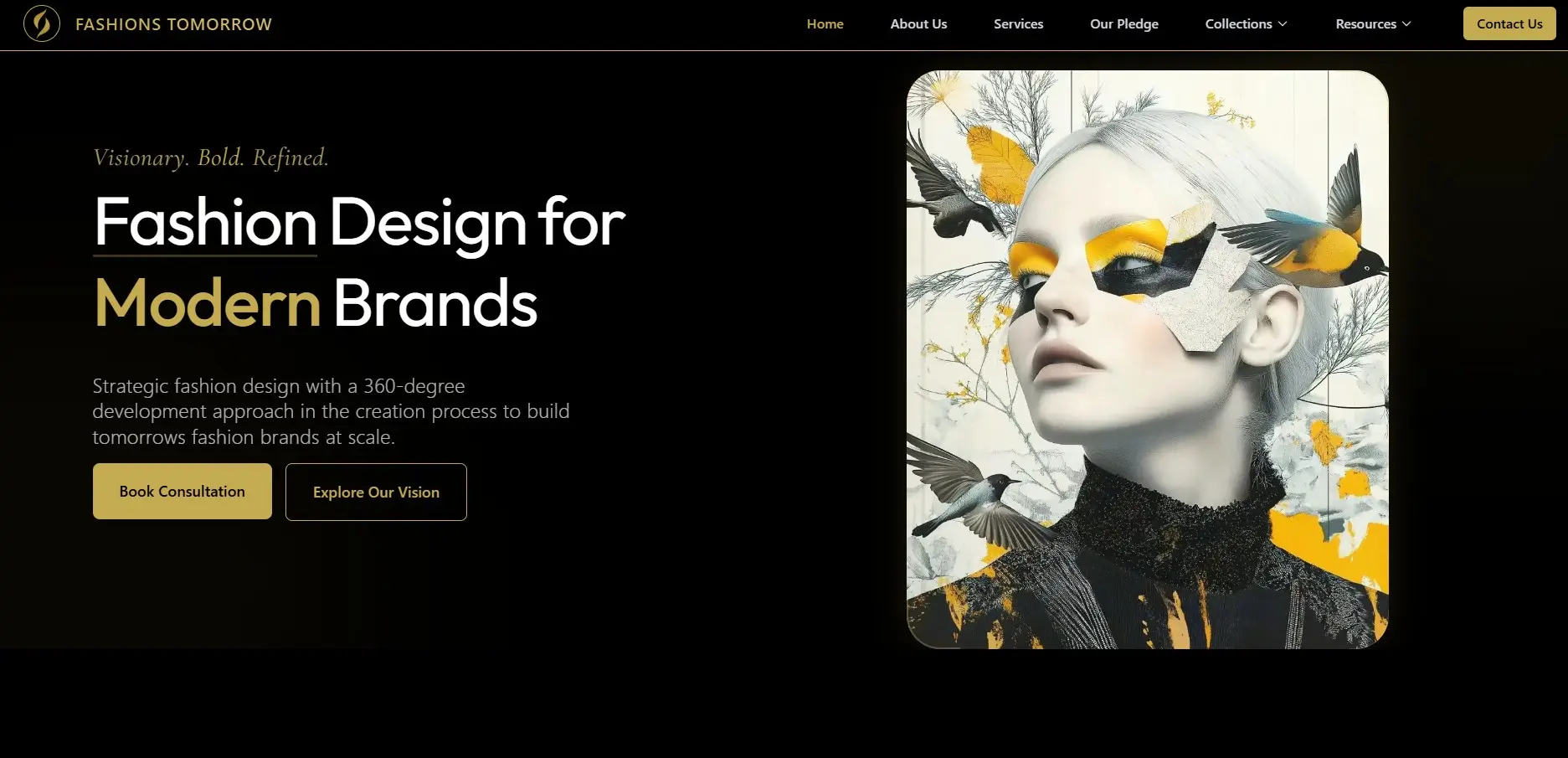
Mobile: runway-ready on every screen

"Thanks Rob, thank you so much for your work and efforts on this — it's taken us like 9 months haha but looks phenomenal. Are you proud of it too? You should be. You did an AMAZING job."— Andrew Dewar, Founder, Fashions Tomorrow
The Tech Specs
For the nerds
project: Fashions Tomorrow
client: Andrew Dewar — Founder
site_url: https://fashionstomorrow.com
build_type: Full brand identity + 22-page custom static website

architecture:
  type: Static HTML + PHP
  cms: none (zero database, zero WordPress)
  css: Tailwind CSS (custom configuration)
  forms: PHPMailer + CSRF + honeypot + rate limiting
  pipeline: Custom Node.js build.js

design:
  sans_serif: Outfit
  serif: Cormorant Garamond
  background: #000000 (Rich Black)
  accent: #C4AB52 (Standard Gold)

deliverables:
  pages: 22
  editorial_articles: 6
  collection_pages: menswear-womenswear, unisex-wear, childrens-wear, product-design

special_features:
  fabric_library: Interactive JS browser, 40+ materials, modal UI
  forms: CSRF-protected, honeypot, 60s rate limiting
  seo: Schema automation (4 types), canonical URLs, sitemap, robots.txt, llms.txt
  headers: HSTS, CSP, X-Frame-Options, Referrer-Policy, Permissions-Policy

security:
  csrf: session-bound token, hash_equals() timing-safe validation
  spam: honeypot fields, silent rejection
  rate_limit: 60-second session cooldown
  sanitisation: filter_input() with multiline handling

build_time: Nine months
Developer Insight // Winston
"The build pipeline processes 22 pages, injects 4 distinct schema types based on page context, generates canonical URLs with trailing-slash normalisation, and outputs a valid sitemap — all from a single npm run build command. Total build time: under 3 seconds. That's faster than WordPress saves a draft."
Got substance but no presence? That's fixable.
We don't do templates. We build proper platforms designed specifically for what you do — and we'll take the time to get it right.
More case studies
See what else we've built — hand-coded, no templates.